|
An
analysis of Angel hair, 1947-2000
by
Brian Boldman
Source:
International UFO Reporter (IUR); Fall 2001, V26 No3, pp 10-20 & 36
Brian Boldman
is an FAA licensed Private pilot and Aircraft Mechanic. After a UFO
sighting in 1989, he began more than a decade of research into the UFO
phenomenon, concluding that physical trace cases, such as angel hair,
might provide the best evidence for the reality of UFOs.
The fall of odd, gossamer-like material from the sky has been reported
many times, sometimes in association with UFOs, sometimes not. Its
origin is mysterious, and because it comes from the sky. It has been
labeled "angel hair." The fall of such material is often considered to
be a part of the UFO phenomenon, specifically a close encounter of the
second kind, or a case that involves physical evidence or some
interaction with the environment. I will show in this article that
angel hair, while rare, is indeed a genuine constituent of the UFO
phenomenon and worthy of further study. To quote NASA scientist Paul
Hill in his book Unconventional Flying Objects:
A consistent
pattern of refuse, determined and documented by the civilian UFO
investigating agencies, is the ejection of a fine, white, translucent
filament that has come to be known as angel hair. No investigation of
this substance commensurate with its potential importance has ever
been made.1
An extensive literature survey turned up 255 cases of angel hair falls
from 679 to 2001. This article will focus on 215 cases from 1947 to
2000. While this is not a huge sample, every effort has been made to
uncover all possible cases, so that there is no selection bias. The
data are assumed to be representative of the phenomenon.
CLASSIC CASES
While not all angel hair falls involve UFO sightings, there have been
several recent high-quality cases with multiple witnesses reminiscent
of the 1952 French cases of Oloron and Gaillac, written about by Aime
Michel and others.
One such case occurred in Quirindi, New South Wales, Australia, on
August 10, I998. In the afternoon, Mrs. Eunice Stansfield, her
daughter, and her son-in-law witnessed "cobwebs" falling from the clear
blue sky along with silver spheres that were performing acrobatic
maneuvers. They were described as "a bright metallic grey" and about
2-3 inches at arm's length. At one lime as many as 20 were in view.
They could stop and hover, or perform rapid right-angle turns.
UFO CLAIMS: Residents of a small
Australian community swear that they saw cobwebs fall from the sky
after UFOs passed overhead. Dozens of residents of Quirindi called
Australia's National UFO hotline after the incident.
Comment: Fell 8/10/98 USA Today
8/11/98 9A
The production of the "exhaust" or angel hair look place during
accelerations or rapid maneuvers; when some of the objects maneuvered
and increased speed, this cobweb-like substance started to drop to the
ground. Some of it got caught on the telephone lines.2 It
was described as white and strong like cotton, but it dissolved away to
nothing while they handled it.3
These are all classic properties of angel-hair cases, where silver
spheres, disks, or cigars are seen discharging a substance, usually on
dry, clear, fall days. The substance hangs on branches, wires,
fences—anything that can catch it—and then just sublimes away to
nothing over a period of hours.
What are the characteristics of angel
hair? Angel hair can be described as a fibrous, web- or silk-like
substance that descends to earth and is notable due to UFOs being
reported concurrently in over half of these cases. It may be fine or
coarse. Vast quantities covering many square miles have been reported,
sometimes draping over utility lines for miles on end. Unusual physical
properties are also widely reported, such as sublimation, or the change
of state of a substance directly from a solid to a gas, bypassing the
liquid state. I will discuss this in some detail as it is reported in a
large percentage of angel-hair cases.
Angel hair is usually described as pure white, but it can also be
various shades of gray, silver, or translucent. In a few rare cases it
has been reported as streaked with gray, or even black. No odor has
been reported except for a camphor-like smell in a few cases. In
several instances where it has been tasted, (not recommended) it was
described as salty. It has also been reported as extremely tough and
hard to break, followed by complete sublimation. Certainly these
features appear to be contradictory, but that is what is reported.
Reports of angel hair have been exceedingly rare during the past few
decades, but trace cases and UFO reports in general also declined.
However, this seems to be changing. There have been at least a dozen
angel-hair cases in recent years, and while this is a paltry number
when compared to the number of UFO reports, CE2 events involving angel
hair cannot he dismissed as illusory. Witnesses widely separated both
temporally and geographically have reported exactly the same
properties. Of the substance; additionally, angel hair is rare enough
that it is doubtful that multiple Witnesses would concoct and stick by
the same story to create a hoax. On top of this, witnesses have
recovered samples of this material that is tangible physical evidence,
albeit ephemeral, that can be tested in a lab—and has been in a few
cases.
Like the UFO phenomenon, there is undoubtedly no single causative
factor for angel-hair falls. But the evidence for a genuine phenomenon
is mounting. Fifty-seven percent of angel-hair cases involve UFO
reports, a significant number, which strongly links the two
phenomena.
ANGEL-HAIR UFOs
The most commonly reported UFO varieties associated with angel-hair
falls are consistent with classic types, such as disks, globes, and
cigars. More recent types, such as triangles, are rare, as are
nocturnal-light cases. There are generally no sounds or odors
associated with the falls. UFO colors reported in descending prominence
are: silver, white, gray, silver-white, black, and a scattering of
orange, blue, and red. Commonly the UFO is described as reflective,
shiny, silvery, or bright.
Out of 215 cases, 72 have descriptions capable of being categorized. In
the case of angel-hair UFOs, almost all are daylight sightings. The
only exceptions in the following table are in the other category, which
includes a few daytime “jellyfish” or “tadpole” types; the rest are
nocturnal lights.
___________________________________________
UFO Types Associated with Anger Hair – 72
Cases__
Disks/Saucers
32 cases (44%)
Globes/Spheres
21 cases (29%)
Cigars
10 cases (14%)
Other
9 cases (12%)
___________________________________________
TIMES
OF FALLS
Fifty-nine cases have information on the time when the fall began, and
some of these include in the total duration of the fall. In 16 cases
where the beginning and ending of the fall was noted, fall limes ranged
from 1 hour to 11 hours, with the average length of fall being 3 hours.
The data indicate that angel hair is mainly an afternoon phenomenon,
with a peak time between 1300 and 1400 hours. The beginning time of
falls where that was reported is summarized in the following table.
Note that fully one-quarter of the cases began between noon and 2 p/m/
local time.
__________________________________
Anger Hair Fall Times (Local time)
Local fall starts
6 a.m. – 12 noon
8 cases (14%)
12:01 – 6:00 p.m. 37 cases
(65%)
12:01 – 2:00 p.m. 14 cases
(25%)
Average start time 1:45 p.m.
__________________________________
WEATHER
Basic weather data was obtained from the National Climatic Data Center
in Asheville, North Carolina, in the form of Local Climatological Data
(LCD) sheets published by the U.S. Department of Commerce. Each LCD is
comprised of a month of observations broken down to daily and hourly
observations at any of 290 National Weather Service stations. However,
to obtain complete weather data for all U.S. angel-hair cases would
require the purchase of multiple data sets at a prohibitive cost.
I visited the NCDC Archives in Asheville in order to obtain LCD
photocopies at a more reasonable cost, as well as foreign weather data.
The results were somewhat disappointing, as not all U.S. records were
available, and foreign daily data were almost impossible to obtain.
Weather data was obtained for 54 U.S. cases, but due to differing
formats, not all parameters are available for all cases.
Due to the limited number of hourly observations available, some of the
weather data can only be presented in a general sense, and is therefore
of limited value. Relative humidity was available for only 15 cases.
The values ranged from 23% to 7l%. Twelve cases (80%) had a relative
humidity less than 50% and the average of all 15 is 40. Total
precipitation for all 54 cases was 1.48 inches; that is, on those 54
days the total sum of all precipitation was 1.48 inches. This is not
very much, and the figure is further skewed by a single case where 1.27
inches fell. With this report removed, the total precipitation for 53
cases is a scant 0.21 inches, which means that angel hair essentially
occurs during dry weather patterns.
___________________________________________
Angel-Hair Weather
___________________________________________
Average
Temp.
58° F.
Max.
Temp.
86° F.
Average
Precipitation
19° F.
Average
Humidity
40%
Average Wind
Speed
6.86 mph
Peak Wind
Speed
30 mph
Average Cloud
Cover
2/10
___________________________________________
Cloud-cover data indicates sunny days were much more common during
angel-hair falls. The data for cloud cover is recorded in tenths. A
fall of 56% of cases had cloud-free skies; the remaining cases were
split, with 1/10 to 5/10 cloud cover in 22%, and 6/10 to 10/10 cover in
another 22%. Average cloud cover is about 2/10, consistent with the
precipitation data.
Perhaps the most important weather data is the percentage of cloudless
days, indicative of a high temperature dew point spread and low
relative humidity. More work needs to be done here, and the data can
only be presented on a preliminary and general basis, but there is
enough to show a general trend of low humidity during angel-hair
days.
ANGEL-HAIR THEORIES
The most prominent theory for angel hair by far is that it is nothing
but the discarded webs of ballooning spiders, or "gossamer." Young
spiders emit strands of silk that have enough drag that rising air
currents pull them aloft. These spiders can rise to thousands of feet
in altitude and travel vast distances. Ballooning spiders have been
known to alight on ships hundreds of miles from land.
Ballooning is done for a variety of reasons. As young spider lings
hatch, population densities soar, and young spiders may soar to escape
overcrowding. Ballooning is also done to escape predation or adverse
environmental conditions. Angel hair is most commonly blamed on
sheet-web weavers (Subfamily Linyphiinac). But crab spiders (Family
Thomisidac) and others are also known to balloon. Spiders balloon most
often on clear, fall days due to the rapid rise in surface temperatures
generating convective currents conducive to ballooning. Angel hair is
also most prominent on these days, and this is why spiders usually take
the rap. However, a closer look at the data will show that a jump to
this conclusion is premature.
Spider silk is an albuminoid protein, made up of the amino acids
glycine, alanine, glutamine, leucine, and tyrosine, and it is one of
the strongest natural fibers known to man. It is five times stronger
than steel of the same diameter, but can be stretched over 130% of its
normal length. Spider silk is even being studied in the hope that
materials stronger than Kevlar can be developed for the manufacture of
more protective bullet-proof vests and parachute shroud lines. In the
South Pacific, raw web silk is used to make fishing nets and bird
snares.
This brings to the lore problems with the spider-web theory. It seems
that a material with such characteristics would hardly sublimate
(dissolve away) as reported. And imagine the chagrin of the poor
arachnids that would never complete their webs as they sublimated out
from under them!
Is it possible that spider web could he responsible for some angel hair
cases? During the July 1968 Symposium on Unidentified Flying Objects
before the U.S. House of Representatives, Dr. Robert M. L Baker
testified that:
Certain soaring Insects—notably "ballooning
spiders"—produce bright-moving points of light. The author has
witnessed such a phenomenon. It is produced by Sun reflections off the
streamers of silken threads spun by many types of spiders. Caught by
the wind, these streamers serve as a means of locomotion floating the
spider high into the air. They occasionally have the appearance of vast
numbers of silken flakes which fill the air and in some recorded
instances extend over many square miles and to a height of several
hundred feet.... Thus the images might he attributed to ballooning
spiders at distances of 50 to 100 feet. However, these web reflections
ordinarily show up only against a rather dark background and it is
doubted if their intensity would be great enough to produce the intense
UFO images against a bright sky.4
From this statement it seems obvious that Dr. Baker is describing the
quick glint that everyone has seen of the sun being reflected off
Spider web. Could UFOs be attributed to such an obvious and common
phenomenon in a high percentage of cases? This author maintains that
while this may be responsible for a few cases, most witnesses are able
to differentiate between the two. The weather data also points against
this theory, as over half of the cases with data available occurred
during bright, clear skies with low humidity, meaning that visibility
was good.
It is certainly possible that a more unusual, but still prosaic, web
structure might be responsible for some cases. Rather than single
strands, or even multiple strands that under ordinary circumstances
would be readily identified, perhaps statically charged webs could
adhere while airborne to form a mass that might easily be mistaken for
a shimmering, silent, hovering UFO. This could also explain the witness
reports of the "ejection" of angel hair as the static charge leaked
away.
So yes, it seems possible that some angel hair cases might
be attributable to spider web, but there are problems with this theory
that will become more apparent later. For now let us wonder what the
stimulus might be to cause UFO reports in 123 out of 215 cases
(57%).
OTHER THEORIES
Angel hair has been blamed on a plethora of materials, from natural
fibers to industrial residues. Cotton, milkweed, nylon, fiberglass or
glass wool, rayon, or radar chaff have all been suggested. It has even
been proposed that angel hair is the product of an alien waste dump!
One of the earliest theories hypothesized that angel hair was
atmospheric dust linked by a static charge. As the charge
dissipated, so did the angel hair, which also explained its sublimation.
Another popular theory involves the polymerization of nitrogen and
oxygen in strong electromagnetic fields surrounding UFOs. The bonds in
these long chain polymers would be unstable, causing the apparent
sublimation. In The Truth about Flying Saucers, Aime Michel
writes about the theories of French Air Force Lieutenant Jean
Plantier:
For, according to Planner, the ionization of
the atmosphere in the wake of the craft would be sufficient (because of
the colossal intensity of the field) to produce ultra-heavy positive
particles, which in contact with the molecules of oxygen, nitrogen,
water, etc., of the surrounding air would exhibit novel chemical
reactions. The product of these reactions—the famous angels' hair—would
disintegrate as the ionization disappeared.5
The production of angel hair has been equated with the manufacture of
cotton candy. Cotton candy is made by introducing molten sugar into a
centrifuge, where it is extruded through small openings into the common
wispy filaments that solidify on contact with air. The actual
generation of angel hair is not known, but scientific analysis may
provide clues.
EARLY
ANALYSIS
Angel hair has baffled main that have tried to analyze it.
Entomologists say it's a fiber, but when the same sample is examined by
a fiber technician who says, no, its spider web. And sometimes the
sample sublimates before any analysis can be done. Here are a few
examples of head-scratchers:
·
"Many witnesses
picked up the fragments of material, which resembled silvery filaments
clinging together like cobwebs, and "wilted away" when handled. A
sample was taken to the police, and a chemist in Graulhet tried to
analyze it, but without success."6
·
'The results of
analysis by several different professional people are strangely
contradictory. It is a significant fact that none of the scientists
identified the material as the web of a ballooning spider."
·
"Six scientists of
the Australian Commonwealth Scientific and Industrial Organization have
studied the threads ... as the threads have a melting quality, they are
further puzzled."8
·
"A fiber technician
with Burlington Industries tested a sample of the 'angel hair’ and said
it was not cotton, wool, or any commercial synthetic yarn. He suggested
that it might be spider webs or a similar animal material. But a
Greensboro biologist examined a sample of the 'angel hair' under a
microscope and said it was 'unlikely' that it was spider webs."9
·
"WSAV-TV gathered
some of the silken threads and took them to the state crime laboratory.
Toxicologist Charles H. Sullenger stared at them through a microscope
and ran several tests on them. Then he announced he didn't know what
they were either."10
It is interesting that in multiple cases, widespread in time and
location, the same elements were detected: silicon, calcium, magnesium,
and boron. Angel hair has been called borosilicate glass due to these
constituents.
·
October 1953.
Victoria, Australia."... a sample was recovered and made available for
laboratory analysis. The examination revealed that the substance
consisted of a nylon-like amorphous mass with traces of magnesium,
calcium, boron and silicon. Since then the original material, which was
kept in an air-tight container shrank from three to a mere half-inch
without residue."11
·
October 27. 1954.
Florence. Italy. "Engineering student Alfredo Jacopozzi collected
samples in a jar and took it to Professor Cozzi at the Institute
of Chemistry at the University of Florence for analysis . . . the
substance contained such known elements as boron, silicon, magnesium
and calcium."12
·
January 17. 1963,
Entre Rios province, Argentina. “…. A formation passed over Entre Rios,
and observer’s recovered vitreous particles that had fallen from them .
. . these particles were found to be an amalgam of silicon, boron,
calcium, and magnesium, just the same as has been found in similar
circumstances in other parts of the world."13
While silicon, calcium, and magnesium are common elements in the
earth's crust, boron is not. It constitutes only 3-10 parts per million
of the crust, making it relatively rare. Why it should turn up in these
samples from three different continents years apart is unknown. Boron
absorbs neutrons and is used to shield and control nuclear reactions,
adding to the speculation that angel hair is a by-product of a nuclear
propulsion system. (An interesting aside involves J. Allen Hynek's
infamous March 1966 "swamp gas" case at Hillsdale College, Michigan.
Analysis of the landing site showed radiation levels higher than the
surrounding area, and the ground was contaminated with boron.)
Other elements found in angel hair include potassium, silicon, calcium,
phosphorus, aluminum, oxygen, chlorine, iron, sulfur, manganese
potassium, sodium, zinc, lanthanum, cesium, and tritium.
The tritium content is particularly interesting. It was found in an
angel hair sample recovered in Sonora, California, on October 12. 1976.
Tritium is a radioactive isotope of hydrogen, and is rare in nature.
Tritium gas is used to boost the yield of nuclear warheads; to obtain
tritium in any appreciable amount it must be man-made in nuclear
reactors or particle accelerators. What this stuff was doing in angel
hair is open to speculation, but to keep this in perspective, there
have only been a handful of cases where angel hair has been reported as
radioactive, and there is probably a more prosaic explanation.
In particular, a possible explanation for radioactive angel hair may be
nuclear testing. For instance, on February 21, 1955, white, fibrous
angel hair covered a half-square mile in Horseheads, New York (see
clipping on the next page, source unknown). It was described as "badly
damaged" radioactive cotton fiber that was impregnated with dirt, had
no odor, did not burn rapidly, and was rapidly disintegrating and
disappearing. No one blamed this fall on spiders.

PROBLEMS
WITH ANALYSES
There are numerous cases in the literature where angel hair was not
even examined, it was just assumed to be spider web. A classic example
of this occurred on October 8, 1969, in St. Louis, Missouri, when a
vast area covering most of the city was blanketed by a pure white,
sticky substance ranging from dime-size to 10-foot long streamers. The
majority of it sublimated on ground contact. Despite the fact that only
a single spider was found, the Smithsonian Institution's Center for
Short-Lived Phenomena concluded the causative factor was ballooning
spiders. When a sample was tested by Dr. Wayne E. Black of the St.
Louis County Health Department, he concluded:
A "ballooning spider" phenomenon does exist:
however, it is doubtful that this was the case in this particular
instance. Laboratory tests on the fiber-like material were negative for
protein which is the basic chemical composition of spider webbing.14
Another example of this occurred in October of 1957, when huge
quantities of a web-like substance fell over a wide area of New Mexico.
Strands as long as 50 feet covered an area from Portales to Hobbs, a
distance of 110 miles. The Portales News-Tribune reported:
Eventually, however, "Dr. William Kister,
University of New Mexico biologist, offered the spider-web explanation
tentatively, without examining the material ... and this was accepted
as the solution of the mystery.15
The most obvious problem with doing any analysis is that angel hair is
known to sublimate, sometimes within minutes, making an analysis
impossible unless a sample is stored in an airtight container. In that
case, gas chromatography can be used if the container is kept sealed.
As in Quirindi, there are other cases where witnesses have added
additional web sample sublimates. This leads to the conclusion that the
substance is spider web sometimes with "contaminants."
Conversely, if true angel hair landed on spider web, and then both were
collected together, the same result could occur. This may have happened
with a sample collected in Midway, Texas, on October 23, 1973. This
sample was analyzed by students at the University of Texas, Austin, and
found to be consistent with Dictyna spider web. This genus of
cribellate spiders does not spin a two-dimensional orb web, but rather
the mass-type three-dimensional web which would be more likely confused
with angel hair. However, the sample did have some unusual
constituents, including Zinc and the rare-earth element lanthanum,
which are never web constituents. It was theorized that the witness
could have witnessed a genuine angel-hair fall, and then collected the
largest mass available, angel hair and the cribellate web.
Even if the sample was not contaminated, knowing only the elemental
constituents is not enough to tell us what angel hair is. Paul Hill
writes:
When we know, or suspect, that a substance is
a complicated molecular compound, it is very little knowledge to know
that some of the atomic constituents are boron, silicon, calcium, and
magnesium. If this analysis were valid, angel hair would resemble fine
wire and would not sublime at ambient temperatures. Among other things,
the negative-valence atoms are missing from this formulation. What is
needed is an analysis of the molecular composition, so that we will
know the molecular compounds which form angel hair.16
We now have a contemporary analysis that can shed light on the
molecular composition of angel hair. Phyllis Budinger of Frontier
Analysis Lid., a very skilled analytical scientist with the capability
to do Fourier Transform Infrared Spectrometry (FT-IR) with a Nicolet
Avatar 360 spectrometer, and Gas Chromatography/Mass Spectrometry
(GC/MS), completed this work. Here are her results from a sample
recovered in Sacramento, California, on November 11, 1999:
The "angel hair" consists of fibrous material
with protein amide type linkages showing it is from an
animal/biological source. The data (FT-IR) compare closest to
references of silk. It is definitely not from cobwebs.
[Emphasis added]
The fibers also have small amounts of an
ester type material and other components on the surface. An attempt is
in progress to further identify them. There are also volatiles
associated with the angel hair. So far light branched hydrocarbons have
been identified (GC/MS). Another test is being done (FT-IR over time)
to determine if there are other volatiles. Some current spectra
indicate there are.
They consisted of: 2-methyl propane:
2-methyl-l-propene; 2-methyl-1-butene; 2-methyl pentane; 3-methyl
pentane; hexane; dimethyl-pentane; 2 C6H12
(molecular weight=84) hydrocarbon structures (specific isomers
unidentified); one C5H16 hydrocarbon (molecular
weight= 112) (specific isomer unidentified). Also indicated are
carbonyl sulfide (COS) and carbon disulfide (CS2). There are possibly
heavier hydrocarbons present such as two C20H42
components and a C23H43 component.
This sample compares with FT-IR spectra in other samples that Budinger
has examined, and there is no question of the composition. It is
positively identified as containing secondary amide linkages similar to
protein, and compares closely to silk. This would seem to add
ammunition to the spider web theory, but the seemingly biological
origin by no means proves this. Also, the addition of volatiles seems
to contradict the spider theory, and may explain sublimation. Moreover,
Budinger believes this is not web material.
SUBLIMATION of ANGEL HAIR
Angel hair sublimation is reported in 40% of the cases. To dismiss
reports of angel hair sublimation would be analogous to dismissing
reports of EM effects or trace cases associated with UFO reports. There
are simply too many credible, competent witnesses who have observed
these effects. One such case with an indisputably credible witness is
worth recapping here.
From his
report to NICAP:
With the intention of examining the strands
under my laboratory microscope when we reached the Seaquarium, I
carefully placed several of them inside a mason jar, allowing them to
cling to the inside of the glass before I capped it. . . .
however, when I opened the jar later in my office, no trace of
the web material could be found.... From the foregoing, I would say
that it is possible that the strands we saw were something other than
spider web, and I have no explanation for the apparent disappearance of
the collected material in the mason jar.17


The degree of reported sublimation is probably due to many variables.
As stated before, angel hair is not one substance, but a complex
polymer that may be composed of a variety of substances, including
volatiles. Most probably, the degree of sublimation is a function of
the volatile content, atmospheric conditions, and the addition of heat.
It is known that refrigerating or freezing angel hair slows or stops
sublimation. This may he due to angel hair being formed in cooler air
at altitude where it may be stable. Witnesses have reported angel hair
actually subliming as it falls before reaching the ground.
Interestingly, there was no indication of a temperature inversion in
the weather data.
The property of sublimation may be used to differentiate "true" angel
hair from fall-outs of industrial residues or natural sources. Spider
web is a common material, even if vast sky falls are not. It would seem
that witnesses would not report sublimation unless this material had
vastly different properties than web material. Witnesses separated by
decades and continents have reported that angel hair has sublimated
in their presence in minutes.
A comparison of weather data between cases with and without sublimation
is shown in the table below. Unfortunately, the data are limited to
only 54 cases, and relative humidity is only available for 15 of these.
Out of these 15 cases, 8 samples sublimated and 7 did not, and the
average relative humidity of the sublimation cases was 45% versus 35%
of the non-sublimation cases. Both sets had at least one case as high
as 71%. This seems to indicate that relative humidity is not
necessarily correlated to sublimation, but is correlated to angel hair
falls, as these are both low figures.
______________________________________________
Sublimation and Weather_________
Sublimation No Sublimation
Average Temp.
58.16°
F
58.40°F
Max.
Temp.
86°
F
73°F
Min.
Temp
19°
F
42°F
Total Precipitation
.04”
1.43”
Relative Humidity
45%
35%
Average Cloud Cover
2/10
2/10
_________________________________________________
Are UFOs linked to sublimation? To test for a statistical
correlation between UFOs and sublimation, I created the table below. We
can see that slightly over half of cases with no sublimation included
the sighting of a UFO, but about two-thirds of the cases with
sublimation had an associated UFO sighting. I used the chi square test
to compare the values of the observed phenomena with those values we
would expect if there were no relationship. If the test is significant,
it implies that UFOs are, in this instance, more likely to be
associated with cases where the angel hair sublimated.
______________________________________________
No
Sublimation
Sublimation Total
UFO Not
Seen
60
32
92
UFO
Seen
70
53
123
Total
130
85
215
______________________________________________
For the above table, chi square is 1.519. For significance at the .05
level, chi square should be 3.84 or greater, so the two characteristics
are not associated. In other words, UFOs do not appear more often when
there is sublimation.
I created a similar table to examine the relationship between UFO waves
and sublimation. We see that almost exactly half of the cases with
sublimation occurred during the October waves (1954 and 1973), and half
in other non-wave periods. A slightly higher percentage of no
sublimation cases occurred in non-wave periods.
______________________________________________
No
Sublimation
Sublimation Total
October
Waves
23
21
44
Non-Wave
Periods
29
22
51
Total
52
43
95
______________________________________________
For the above table, chi square is again non-significant, so cases with
sublimation do not appear more, or less often, during UFO waves.
The fact that there are no significant associations in the above data
is interesting. This does not mean that angel hair is spider web, or
conversely that all angel hair is not. This is certainly not the case,
and there are clearly properties not accounted for. Also, UFOs are
probably under-reported in angel-hair cases, although UFOs observed in
57% of all angel-hair cases is certainly significant. This is because a
UFO may pass by and drop angel hair, but only the angel hair be seen
when it falls onto the ground or vegetation.
ANGEL-HAIR CASE PROPERTIES
The relative numbers of cases with sublimation, UFOs, UFOs and
sublimation, and just angel hair are shown in Chart 1. The October peak
is very apparent, with 45% of all cases, October and November account
for fully 63% of all cases. Out of 123 total cases with a UFO report,
October has an astounding 56 or 45%. November has 24 or 20%.
_________________________________________________
Case percentages by month –215 cases total________
January
1.8%
July
5.1%
February
3.2%
August
5.5%
March
2.3%
September 6.9%
April
1.8%
October
45.1%
May
5.5%
November 18.1%
June
5.1%
December 1.8%
_________________________________________________
CORRELATION to UFO WAVES
One of the mysterious features of the angel-hair enigma is that while
it shows definite signs of connections to UFOs, it is not prominent in
all UFO waves. Looking at the classic wave years of 1947, 1952, 1954,
1957, 1966-1967, and 1973, a very interesting correlation emerges.
In this macro view (Chart 21, angel hair seems to track the UFO data
(from Larry Hatch's "U* Database (www.larryhatch.net) only
somewhat, with an exception being the large spike of the 1954 wave, and
a small spike during the 1973 wave. There is no correlation with the
1947, 1952, 1957, and the 1966-1967 waves. There is a very specific
correlation to the 1954 and 1973 waves, which were both in October. The
1947 wave is totally devoid of angel hair, but there were very few
trace cases of any kind associated with this wave. The 1952 and 1957
waves are also negatively correlated with angel hair. The lack of
angel-hair cases during the 1966-1967 waves is a real mystery, given
the unrivaled volume of UFO reports during these years. Ted Phillips's
data indicate there was a plethora of trace cases during these years,
and angel hair seems to track the EM and trace data.
A note should also be made concerning 1977-1978. There was a
long-lasting worldwide wave that was most prominent in the Southern
hemisphere, although the United States was not devoid of high quality
cases. There were seven angel-hair eases in 1977, but only one in 1978.
Since the wave was primarily in 1978, these cases may or may not be
wave related.
While not all waves involve angel hair, the 1954 and 1973 waves are
correlated to angel-hair falls. This leads to the question: What do
these waves have in common, and what differentiates them from the
others? The answer is that these are both classic explosive
short-term October waves. The characteristics of a classic
short-term, broad distribution wave as defined by Eddie Bullard
are:
For two weeks to perhaps three or tour
months, UFOs by the thousands appear in national and international
skies, attract temporary media attention, then disappear once again.
... An explosive wave begins with a spectacular, well-publicized
triggering event, builds up in a few days and spreads quickly over a
widening area, peaks, and then falls off rapidly, typically spanning
about three weeks.18
The 1954 European (France and Italy) and the 1973 U.S. October waves
were very similar in duration, but the 1954 wave had 4.5 times as many
angel hair cases. Both of these waves were replete with a large
quantity of high strangeness cases of high quality involving entity
sightings, electromagnetic (EM) effects, and angel hair peaks
coincident with the wave peaks.
The uncorrelated waves either had July peaks (1947, 1952) or were
pandemic (1966-1967) or widespread, long-lasting, and global in nature.
The 1957 wave occurred in November, and there is no correlation to this
wave.
A cursory look at the table at the bottom of the page may only seem to
reveal the widely known annual October peak (note how even in 1957
there were cases in October but none in November), but a closer
examination of the case distribution during the actual waves themselves
indicates a subtle, more precise correlation. Note that the case
numbers during these years were essentially flat until the October
peak. A closer examination of the case distribution during these waves
shows several very interesting correlations.
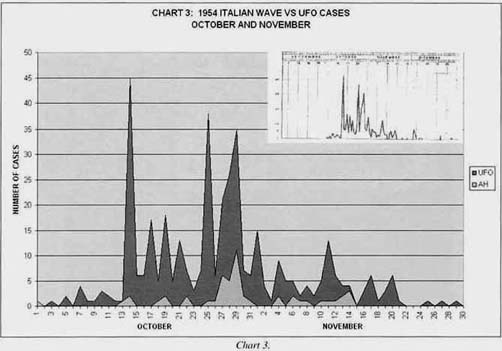
The angel hair peak for this century is in October of 1954, and is
quite obvious in Chart 2. As mentioned above, angel hair cases also
correlate with this wave. Chart 3 shows very graphically that the peak
case dates coincide for UFO cases and angel hair cases in the Italian
wave.


____________________________________________________________________________________________
Full wave years – Angel Hair cases
Jan
Feb Mar
Apr May
Jun
Jul
Aug Sep Oct
Nov Dec
1954
0
2
0
0
1
1
0
0
1
36
16 2
1957
0
0
0
2
0
0
0
0
2
5
0
0
1973
0
0
0
0
1
0
0
0
1
8
1 0
____________________________________________________________________________________________
THE 1973 WAVE
Even before the peak of the wave, high-quality witnesses had reported
UFOs. Of these, none other than Ohio Governor John Gilligan witnessed a
UFO on October 15, and Walter Cronkite reported this on the CBS evening
news. There were angel hair cases on the 17th, 18th, 22nd, and 23rd.
The peak date of the wave was the 18th. There were five angel-hair
cases on the 18th, from Illinois to Louisiana. The following news
clipping from the New Orleans Times-Picayune, October 19, 1973, is
representative of the October 18 angel-hair press coverage of the south
central U.S.
Odd Substance Drifts from Sky
SHREVEPORT, La. (AP) – UFO stood for “Unknown Falling Objects” around
north-western Louisiana Thursday afternoon.
Officials were ballder.
The odd filmy substance drifted down from a clear blue sky. It was
reported here, at Springhill – even at Ruston, 60 miles to the east.
It looked like strings of cotton or silk – or like the threads of a
spiderweb – sometimes five to six feet long.
At some points, observers said the odd ribbons festooned trees and
power lines.
Another angel-hair case on the 18th occurred in Hamilton, Illinois, at
3:30 p.m. The witnesses observed what was described as a huge oval or
oblong UFO that was described as near gray in color. A second object
was then seen that resembled the first object, but seemed to be covered
with "cobwebs" on the upper surface. About 15 minutes later,
'"cotton-like" material was found that when handled "became a small
ball which melted as it was touched." The next morning a sample that
was retrieved had totally sublimated.19
CORRELATION TO ENTITY SIGHTINGS
Both the 1954 and 1973 waves included many entity reports. One of the
most famous of these occurred on October 11, 1973, involving Charles
Hickson and Calvin Parker. The details are widely known and available,
so only a brief synopsis will be given.
Around 5 p.m., Hickson and Parker were fishing on the Pascagoula River
in Mississippi. They observed a football-or cigar-shaped UFO, and then
were taken into the object where they were examined by very strange
creatures with gray skin and claws for hands. What impressed the
investigators of this case (including Hynek) was the veracity of the
witnesses, including secret recordings where they discussed the
experience, and later polygraph tests that they both passed.
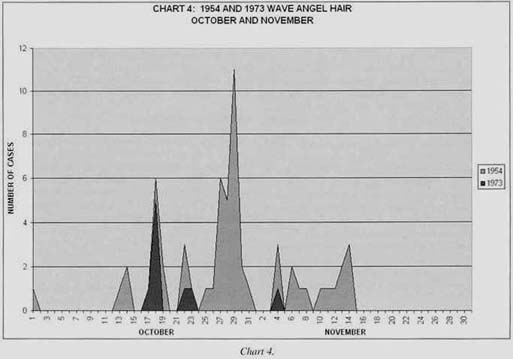
What is really interesting about the entity reports is that they
correlate with the peaks of both waves. Compare Chart 4 with Chart
5.

CONCLUSION
The correlations with the 1954 and 1973 waves seem to be very strong
evidence that angel hair is a constituent of the UFO phenomenon.
Further evidence of this is the high percentage of UFOs concurrent with
angel-hair falls, and the number of reports of sublimation. The entity
reports provide a three-way correlation.
If the spider-web theory were correct, then we would have to conclude
that many UFO reports, and even UFO waves, are stimulated by web
material in the sky. But if angel hair is primarily spider web, and
spider ballooning is a well-known natural phenomenon, why were there so
few-reported cases during the 80s and 90s? We would expect a naturally,
occurring phenomenon to lead to relatively constant numbers over time,
without such wide variation.
If spider webs are angel hair, then we have been the victims of a cruel
joke of nature, the similarity of two separate phenomena, bold in
appearance and pattern. But I consider spider web to be a red herring.
Charles Fort put it like this:
It's difficult to express that silky
substances that have fallen to this earth were not spider webs. My own
acceptance is that spider webs are the merger; that these have been
falls of an externally derived silky substance, and also of the webs,
or strands, rather, of aeronautic spiders indigenous to this earth;
that in some instances it is impossible to distinguish one from the
other.
While it is true that correlation does not prove causation, the
evidence seems overwhelming that angel-hair cases are indeed related to
genuine UFOs, and provides more evidence of their reality. Both UFOs
and angel hair deserve the serious attention of the scientific
community.
ACKNOWLEDGEMENTS
The author wishes to thank Mark Rodeghier, Frank J. Reid, and all
others at CUFOS for their very helpful and patient assistance: Phyllis
Budinger of Frontier Analysis, Ltd. for her time and expertise in
sample analysis; Edoardo Russo and Massimiliano Grandi of Centro
Italiano Studi Ufologici (CISU) for data on Italian cases; Larry Hatch
for various UFO data: and assorted archivists and librarians for their
assistance.
ENDNOTES
1.
Paul R. Hill, Unconventional Flying Objects: A
Scientific Analysis (Charlottesville, Va.: Hampton Roads, 1995),
p.225.
2.
Tamworth (New
South Wales) North Daily Leader,
August 8, 1998.
3.
Australian UFO
Reports and Encounters, no.
7, September 1998.
4.
UFO Symposium 1968, Robert M. L. Baker, Jr. statement,
912a-87.umd.edu/ufosymposium/baker.html.
5.
Aime΄ Michel, The Truth about Flying Saucers (New
York: Criterion, 1956), p. 221.
6.
Aime΄ Michel, Flying Saucers and the Straight-Line
Mystery (New York: Criterion, 1958), p. 170.
7.
Charles A. Maney, in Flying Saucer Review, vol. 2,
no. 6, p. 18.
8.
“Falls,” Doubt, no. 53 (1956): 417.
9.
Greensboro (N.C.)
Daily News, October 29, 1955.
10.
Savannah (Ga.)
Morning News, November 4,
1959.
11.
Keith Basterfield, Australian Flying Saucer Review
(N.S.W.), no. 9, p. 12.
12.
Saga, December 1975.
13.
Flying Saucer
Review, November/December
1965.
14.
“A Classic Case of ‘Angel-Hair’,” Pursuit 3, no. 4
(October 1970): 72-73.
15.
Portales (N.
Mex.) News Tribune, October
27, 1955.
16.
Hill, Unconventional Flying Objects, p. 240.
17.
Ted Phillips, letter to NICAP.
18.
Thomas E. Bullard, in Richard Hall, ed., The UFO
Evidence, Vol 2, p. 309.
19.
CUFOS (NICAP) file.
|