|
The Nike Missile System A Concise Historical Overview
By Donald E. Bender
Updated 16 July 1999
Origins Of The Nike System
Nike, named for the mythical Greek goddess of victory, was
the name given to a program which ultimately produced the world's first
successful, widely-deployed, guided surface-to-air missile system.
Planning for Nike was begun during the last months of the Second World
War when the U.S. Army realized that conventional anti-aircraft
artillery would not be able to provide an adequate defense against the
fast, high-flying and maneuverable jet aircraft which were being
introduced into service, particularly by the Germans.
During 1945, Bell Telephone Laboratories produced the "AAGM
(Anti Aircraft Guided Missile) Report" in which the concept of the Nike
system were first outlined. The Report envisioned a two-stage,
supersonic missile which could be guided to its target by means of
ground-based radar and computer systems. This type of system is known
as a "command" guidance system. The main advantage over conventional
anti-aircraft artillery was that the Nike missile could be continuously
guided to intercept an aircraft, in spite of any evasive actions taken
by its pilot. By contrast, the projectiles fired by conventional
anti-aircraft artillery (such as 90mm and 120mm guns) followed a
predetermined, ballistic trajectory which could not be altered after
firing.
The Nike Mission
During the first decade of the Cold War, the Soviet Union
began to develop a series of long-range bomber aircraft, capable of
reaching targets within the continental United States. The potential
threat posed by such aircraft became much more serious when, in 1949,
the Russians exploded their first atomic bomb.
The perception that the Soviet Union might be capable of
constructing a sizable fleet of long-range, nuclear-armed bomber
aircraft capable of reaching the continental United States provided
motivation to rapidly develop and deploy the Nike system to defend
major U.S. population centers and other vital targets. The outbreak of
hostilities in Korea, provided a further impetus to this deployment.
The mission of Nike within the continental U.S. was to act
as a "last ditch" line of air defense for selected areas. The Nike
system would have been utilized in the event that the Air Force's
long-range fighter-interceptor aircraft had failed to destroy any
attacking bombers at a greater distance from their intended targets.
Nike Deployment
Within the continental United States, Nike missile sites
were constructed in defensive "rings" surrounding major urban and
industrial areas. Additional Nike sites protected key Strategic Air
Command bases and other sensitive installations, such as the nuclear
facilities at Hanford, Washington. Sites were located on
government-owned property where this was available (for example, on
military bases). However, much real estate needed to be acquired in
order to construct sufficient bases to provide an adequate defense.
This was a sometimes difficult and contentious process. Often, the
federal government had to go to court in order to obtain the property
needed for such sites.
The exact number of Nike sites constructed within a
particular "defense area" varied depending upon many factors. The New
York Defense Area -- one of the largest in the nation -- was defended
at one time by nearly twenty individual Nike installations. Due to the
relatively short range of the original Nike missile, the Nike "Ajax",
many bases were located relatively close to the center of the areas
they protected. Frequently, they were located within heavily populated
areas.
Nike Ajax missiles first became operational at Fort Meade,
Maryland, during December, 1953. Dozens of Nike sites were subsequently
constructed at locations all across the continental United States
during the mid fifties and early sixties. Roughly 250 sites were
constructed during this period. Nike missiles were also deployed
overseas with U.S. forces in Europe and Asia, by the armed forces of
many NATO nations (Germany, France, Denmark, Italy, Belgium, Norway,
the Netherlands, Greece and Turkey), and by U.S. allies in Asia (Japan,
South Korea, and Taiwan).
A "Typical" Nike Site
A "typical" Nike air defense site consisted of two separate
parcels of land. One area was known as the Integrated Fire Control
(IFC) Area. This site contained the Nike system's ground-based radar
and computer systems designed to detect and track hostile aircraft, and
to guide the missiles to their targets.
The second parcel of land was known as the Launcher Area. At
the launcher area, Nike missiles were stored horizontally within
heavily constructed underground missile "magazines". A large, missile
elevator brought the Nikes to the surface of the site where they would
be pushed (manually) by crewmen, across twin steel rails to one of four
satellite launchers. The missile was then attached to its launcher and
erected to a near-vertical position for firing. The near-vertical
firing position ensured that the missile's booster rocket (lower stage)
would not crash directly back onto the missile site, but, instead,
would land within a predetermined "booster impact area".
The control and launcher areas were separated by a distance
of 1,000 to 6,000 yards (roughly 0.5- to 3.5-miles) and were often
located within different townships. Technical limitations of the
guidance system required the two facilities to be separated by a
minimum of 3,000 feet. Whenever possible, control areas were
constructed on high ground in order to gain superior radar coverage of
the area. Control areas were generally located between the area being
defended and the launcher area containing the missiles.
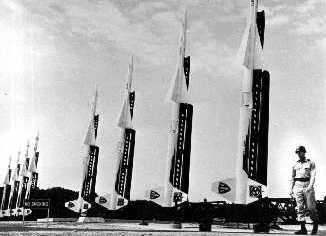
Nike "Ajax": The First Nike Missile
The first successful test firing of a Nike missile occurred
during 1951. This first Nike missile was later given the name Nike
"Ajax". Nike Ajax was a slender, two-stage guided missile powered by a
liquid-fueled motor utilizing a combination of inhibited red fuming
nitric acid (IRFNA), unsymmetrical dimethyl hydrazine (UDMH) and JP-4
jet petroleum. The Ajax was blasted off of its launcher by means of a
jettisonable solid fuel rocket booster which fired for about 3 seconds,
accelerating the missile with a power of 25 times the force of gravity.
The Ajax missile was capable of maximum speeds of over
1,600-mph and could reach targets at altitudes of up to 70,000 feet.
Its range was only about 25 miles, which was too short to make it a
truly effective air defense weapon in the eyes of its many detractors.
Its supporters countered that the new missile was markedly superior to
conventional antiaircraft artillery, and that it was, significantly,
the only air defense missile actually deployed and operational at that
time.
Nike Ajax was armed with three individual high-explosive,
fragmentation-type warheads located at the front, center and rear of
the missile body. Although consideration was given to arming the Ajax
with a nuclear (atomic) warhead, this project was canceled in favor of
developing a totally new, much-improved Nike missile. Even as the first
Nike Ajax missiles were being deployed across the nation, work on its
successor, first known as "Nike-B" and later as Nike "Hercules" had
already begun.
The Nike "Hercules" Missile
Work on a successor to the first Nike missile, the Nike
"Ajax", was initiated well before the first Ajax missiles were deployed
at sites across the nation. Two primary considerations drove the
development of the this second-generation Nike missile. The first
involved the need to field a missile with improved capabilities to
defend against a new generation of faster and smaller targets,
including supersonic aircraft and tactical ballistic missiles. The
second was the desire to arm this new missile with a powerful atomic
warhead.
Originally designated as "Nike B", the Nike "Hercules" -- as
this missile was later known -- was a far more capable missile than its
predecessor (the Nike Ajax) in nearly every way. With a maximum range
of about 90 miles, maximum speeds of over 3,200 mph, and the ability to
reach targets at altitudes in excess of 100,000 feet, the Nike Hercules
was a very potent air defense weapon. The Hercules missile lacked most
of the complex, miniaturized vacuum tubes utilized by the Ajax, and
employed solid rocket fuel in its "sustainer" motor which made it
easier and safer to manage than the Ajax which employed highly caustic
liquid fuel components.
Unlike the Ajax, the Hercules was designed from the outset
to carry a nuclear warhead. Designated "W-31" the Hercules nuclear
warhead was available in three different yields: low (3-Kilotons);
medium (20-Kt.) and high (30-Kt.). For purposes of comparison, the
atomic bomb dropped on Hiroshima, Japan, near the end of the Second
World War had a yield of approximately 15 Kilotons.
Armed with its nuclear warhead a single Nike Hercules
missile was capable of destroying a closely spaced formation of several
attacking aircraft. This warhead enabled the Hercules to destroy not
only the aircraft, but also any nuclear weapons they carried,
preventing them from being detonated. Some of the first Hercules
missiles deployed in the United States were initially equipped with the
heavier "W-7" nuclear warhead.
The Hercules could also be equipped with a powerful,
high-explosive, fragmentation-type warhead designated "T-45". The
warhead provided a useful alternative to the W-31 (particularly for use
against a single aircraft and for low altitude use in proximity to
populated areas) and was deployed at many overseas sites. Additional
warhead designs, including "cluster" type warheads containing numerous
submunitions, were developed although not deployed operationally on the
Nike Hercules missile.
More sophisticated radar and guidance systems were also part
of the Hercules "package". These made the Hercules system more accurate
and effective at longer ranges. During the early sixties, an "improved"
version of the Hercules system, utilizing ABAR (Alternate Battery
Acquisition Radar) or HIPAR (High Power Acquisition Radar) was
deployed. The improved radar capabilities and other advanced electronic
features of the Improved Hercules system made it more effective against
small supersonic targets including aircraft, aircraft launched
"stand-off" missiles, and tactical ballistic missiles.
An relatively unknown fact is that the Hercules missile
could also be used in a surface-to-surface mode. In this role, the
Hercules would have been used to deliver tactical nuclear warheads to
destroy concentrations of enemy troops and armored vehicles, or
bridges, dams and other significant targets from bases and field
deployments located primarily within Western Europe. This surface
capability might also have proven useful in other areas where the
Hercules missile was deployed including South Korea, Taiwan, and Turkey.
Maximum range of the Hercules missile in the
surface-to-surface mode was slightly over 110 miles, and was limited by
the effective transmission range of the Missile Tracking Radar (MTR).
Although deployed at permanent sites within the continental
United States, and at many overseas locations, mobile Nike Hercules
batteries increased the flexibility and usefulness of this system,
permitting the powerful capabilities of this versatile missile system
to be extended wherever this could prove useful. Trucks and trailers
were used to transport Nike Hercules system components to the desired
field locations. In this mode, a single missile was mounted upon a
truck-drawn trailer/launcher unit which also served as a firing
platform.
Guidance & Control
Unlike some modern missile systems, Nike was guided entirely
from the ground, from firing to warhead detonation. The electronic
"eyes" (radar) and "brain" (computer) of the Nike system were located
on the ground, within the Integrated Fire Control Area.
At the IFC area, hostile aircraft were first identified by
means of an acquisition radar (ACQR). This radar was manned 24 hours
per day, scanning the skies for indications of any hostile aircraft.
"Friendly" aircraft were automatically identified by means of
electronic signals generated by IFF ("Identification Friend or Foe") or
SIF ("Selective Identification Feature") equipment.
In practice, this target information would normally have
been received from Air Force long range radar sites, by means of the
Air Force's SAGE (Semi Automatic Ground Environment) system and other
sources including Army "Missile Master" sites and related facilities,
in order to provide an advanced warning for the missile batteries.
Having acquired and positively identified a hostile
aircraft, a second radar, the Target Tracking Radar (TTR) would be
aimed at and electronically locked onto it. This radar would then
follow the selected aircraft's every move in spite of any evasive
action taken by its pilot. A third radar, the Missile Tracking Radar
(MTR) was then aimed at and electronically locked onto an individual
Nike missile located at the nearby Launcher Area.
Both the TTR and MTR were linked to a guidance computer
located at the IFC Area. This analog computer continuously compared the
relative positions of both the targeted aircraft and the missile during
its flight and determined the course the missile would have to fly in
order to reach its target. Steering commands were computed and sent
from the ground to the missile during its flight, via the Missile
Tracking Radar. At the moment of closest approach the missile's warhead
would be detonated by a computer generated "burst command" sent from
the ground via the MTR.
For surface-to-surface shots, the coordinates of the target
were dialed into the computer and the height of burst was set by crew
members at the Launcher Area. The standard technique was for the
missile's guidance signal to be terminated as it dove vertically onto
its target. Detonation of the warhead was via the pre-set barometric
fusing. Alternately (and presumably as a back-up system) the warhead
could be exploded via contact fusing when it impacted the selected
target or target area.
End Of The Nike Era
Although Nike was created in response to Russian efforts to
design and deploy long-range bomber aircraft during the early years of
the Cold War, Russian military strategy soon changed. Fearing that
their manned aircraft would be too vulnerable to attack by supersonic
American interceptor aircraft armed with rockets and missiles, the
Russians decided to focus their attention on developing ICBMs --
Intercontinental Ballistic Missiles -- against which there existed no
effective defense. As a result, the Russians never deployed a large and
capable strategic bomber force comparable to the Strategic Air Command
of the United States Air Force.
The shifting nature of the Soviet threat meant that the air
defense role, for which Nike was originally intended, became relatively
less critical as time passed. Defense dollars were needed for other
projects (including the development of American ICBMs and potential
missile defenses) and to fund the rapidly growing war in Vietnam.
Accordingly, beginning in the mid 1960s, the total number of
operational Nike bases within the continental U.S. was steadily reduced
on an almost annual basis.
The signing of the SALT I treaty in Moscow during the spring
of 1972 limited the number of missiles with ABM (Anti-Ballistic
Missile) capabilities. Nike Hercules, due to its limited capabilities
against certain types of ballistic missiles, was included in this
treaty. During 1974, all remaining sites within the nationwide Nike air
defense system were inactivated. Army Air Defense Command (ARADCOM)
which administered this system was closed down shortly thereafter. One
of the nation's most significant Cold War air defense programs had come
to an end.
In spite of the termination of the nationwide Nike program,
Nike missiles remained operational at sites in Florida and Alaska for
several more years. Others remained operational with U.S. forces in
Europe and the Pacific, and with the armed forces of many U.S. Allies
overseas. Although no longer in the U.S. inventory, more than four
decades after the first Nike missile became operational in the U.S.,
Nike Hercules missiles are today deployed by the armed forces of U.S.
allies in Europe and Asia, and are likely to remain in service well
beyond the year 2000.
|
| Nike
Missile Specifications & Performance Data Dillsboro UFO Incident Directory NICAP Home Page |